


What Hezbollah Really Wants and Why It's Not Just About Land

Hezbollah did not become the most heavily armed non state actor on earth to take a few square kilometers of farmland. The Shebaa Farms, the disputed sliver of territory often cited as the pretext for the group's continued armament, would not fill a suburb of Beirut. Yet for more than four decades, the Party of God has built tunnels, stockpiled missiles, fought wars across borders, and embedded itself in the Lebanese state, all while insisting that its weapons exist solely to liberate occupied land. The land matters. But it is the smallest part of the story.
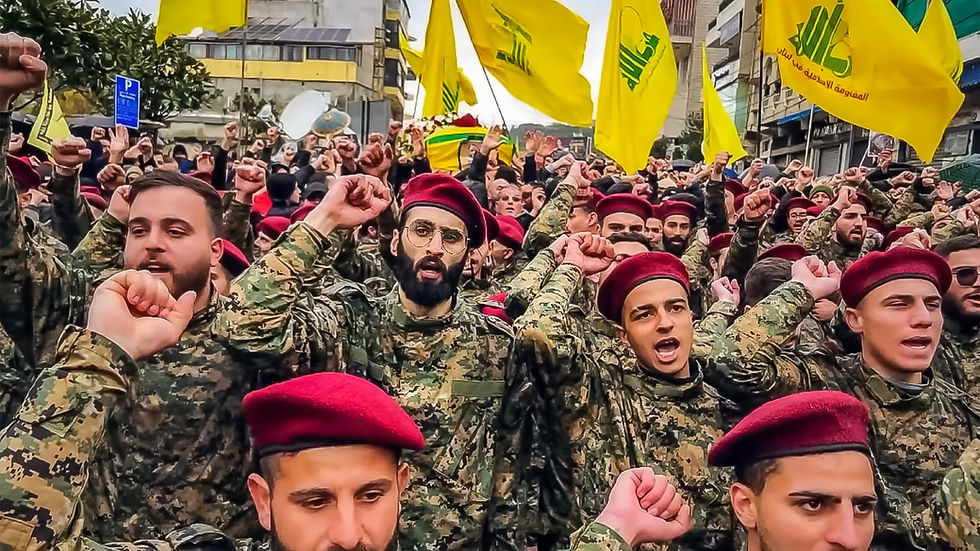
To understand what Hezbollah really wants, you have to begin with the year it was born. In 1982, Israeli forces drove deep into Lebanon to expel the Palestine Liberation Organization. They encountered, almost by accident, a Shia community that had spent decades at the bottom of Lebanon's sectarian hierarchy. Iranian Revolutionary Guard officers, dispatched by a regime barely three years old in Tehran, found fertile ground among young Shia clerics and fighters who had absorbed the language of Ayatollah Khomeini's revolution. Hezbollah was the offspring of that meeting. It was not founded to fix a border. It was founded to advance a project.
That project has three layers, and only the outermost one concerns territory.
The first layer is ideological. Hezbollah is, at its core, a Khomeinist organization. Its founders pledged loyalty to the wilayat al faqih, the doctrine that places ultimate political and religious authority in the hands of Iran's Supreme Leader. This is not a symbolic gesture. It means that Hezbollah's senior decisions, especially on questions of war and peace, are made in consultation with Tehran.
When the group's leadership speaks of resistance, it is invoking a worldview in which the Islamic Republic stands as the vanguard of an oppressed Muslim world against a global order led by the United States and Israel. Withdrawing from contested land does not close that struggle. Nothing does.

The second layer is sectarian and communal. Before Hezbollah, Lebanese Shia were largely invisible in their own country, poor, rural, and politically marginal. Hezbollah changed that, not only through arms but through a sprawling network of schools, hospitals, charities, and reconstruction agencies that functions, in much of the south and the Bekaa, as a parallel state. For many Shia Lebanese, the party is not simply a militia. It is the institution that paved their roads, paid their tuition, and rebuilt their homes after wars. Giving up its weapons would mean giving up the leverage that protects that empire of services (that only takes care of the Shia Muslims in Lebanon) and the political power that flows from it. Land or no land, Hezbollah will not voluntarily disarm into a state it does not trust to safeguard its community.
The third layer is regional. Hezbollah is the most successful component of what Iran calls the Axis of Resistance, a network of allied militias stretching from Yemen through Iraq and Syria to Lebanon. Its missile arsenal, estimated in the tens of thousands of projectiles before the most recent war, was always meant to do more than threaten Israel's north. It was meant to deter any strike on Iran's nuclear program. It was the forward shield of Tehran's deterrent posture. When Israeli officials describe Hezbollah as Iran's most valuable strategic asset, they are not exaggerating. The group is not a Lebanese militia that happens to receive Iranian funding. It is, in important respects, an Iranian military formation that happens to be based in Lebanon.

This is why the wars of 2006 and the more recent rounds of fighting never truly ended on borders. The struggle over villages and hilltops obscured the deeper question, which is whether Lebanon will remain a country in which one armed faction, answerable to a foreign capital, holds a veto over national decisions of war and peace. The latest war did profound damage to Hezbollah's military leadership and arsenal, and the political ground in Beirut has shifted. But the project that animates the party has not changed. Its leaders still speak of resistance as an open ended vocation, not a finite mission.
Outside observers often hope that a sufficiently clever land deal can buy quiet. That hope misreads the organization. Hezbollah's leadership has never described its purpose in terms a real estate transaction could satisfy. It speaks of identity, of faith, of a regional order to be overturned. Land is the easiest piece to negotiate. Everything else is what makes negotiation so hard.
Until the world reckons with the ideology, the community, and the regional strategy behind the rockets, every ceasefire will be temporary, and every map redrawn will be redrawn again.


Ragarding https://sling-tv.pissedconsumer.com/customer-service.html I had the pleasure of interacting with Sling TV's customer service, and I must say, it was a refreshing experience! The representatives were not only friendly but also incredibly knowledgeable, quickly resolving my issue with ease. I appreciated their prompt responses and the clear communication throughout the process. Overall, my experience left me feeling valued as a customer, and I’m excited to continue enjoying my Sling TV subscription!
Referring page from espn reviews offers a comprehensive and engaging experience for sports enthusiasts. The user interface is intuitive, allowing for seamless navigation through a plethora of live events, highlights, and analysis. The quality of the streaming is consistently high, ensuring that viewers do not miss a moment of the action. Additionally, the depth of coverage across various sports is impressive, catering to both casual fans and dedicated followers alike. Overall, ESPN Media stands out as a premier destination for sports content.
Excellent analysis that should be required reading for all the feckless Western politicians who play footsies with islamists and think they can be placated with "agreements." A key attribute of islamism is the universal practice of deception in dealing with non Muslims. They cannot be trusted. We are where we are now because we haven't UTTERLY ANNIHILATED the islamists. If the world wants true peace, then all islamists must die. May God Almighty continue to love and protect and BLESS Israel.